AI-First Mobility: The Next Taxi Revolution Won’t Be Another App
From traditional taxi dispatch to conversational booking and AI agents: a new era of mobility is emerging. UrbanGo is preparing independent taxi and private hire operators for that future, starting with the technology they use to manage rides today.

For more than a decade, the transformation of urban mobility has been defined by a simple action: opening an app.
Enter a destination. Choose a service. Confirm the booking.
Companies such as Uber helped turn that sequence into an everyday habit, reshaping how passengers find transport and how operators compete for customers.
But the next transformation could look very different.
What if the next generation of taxi booking begins not with an app, but with a conversation?
Artificial intelligence is creating new ways for people to interact with digital services. Instead of navigating menus and completing forms, users can increasingly describe what they want in natural language.
For the taxi and private hire industry, this raises a question that goes far beyond convenience: when passengers start asking AI assistants for transport, which operators will receive those requests?
For UrbanGo, that question is central to the future of independent mobility.
A changing industry: 19,000 private hire operator licences in England
The British taxi and private hire market offers a useful perspective on the scale of the opportunity.
According to the UK Department for Transport, England had approximately 19,000 licensed private hire vehicle operator licences as of 1 April 2026, compared with 16,300 in 2024, an increase of 17%. The figures represent operator licences rather than necessarily 19,000 separate businesses, since an operator may hold licences issued by more than one authority.
The same official statistics recorded approximately 290,000 licensed private hire vehicles and 52,300 licensed taxis in England. Source: Department for Transport, Taxi and Private Hire Vehicle Statistics, England: 2026.
Yet these figures leave an important commercial question unanswered.
The Department for Transport explains that its statistics do not identify which individual drivers use app-based platforms. As a result, they cannot show how much work reaches drivers through particular booking applications.
That distinction matters.
Knowing how many vehicles are licensed tells us about the supply of transport. It does not tell us who controls access to passenger demand. And in an increasingly digital market, the channel through which a booking arrives can be almost as strategically important as the vehicle that completes it.
AI could introduce another such channel.
What is AI-first mobility?
AI-first mobility describes an approach in which artificial intelligence becomes a fundamental component of mobility services, rather than simply an optional feature. It can influence how customers make requests, how operators process information, how journeys are planned and how fleets are managed.
Several related concepts are worth distinguishing.
AI-assisted dispatch uses intelligent capabilities to support existing operations. These might include estimated arrival times, recommendations, or assistance with managing incoming work.
Conversational ride booking allows a journey request to be expressed in natural language. Rather than entering information into several fields, a user describes the journey, and the system interprets the relevant details.
AI-first mobility takes a broader approach, considering how intelligent capabilities can be integrated into the design and operation of mobility services.
Agentic mobility explores a further possibility: AI agents interacting with transport providers on behalf of passengers, retrieving available options and potentially completing bookings with the necessary authorisation.
These are emerging concepts, not universally standardised industry categories. They can overlap, but they are not interchangeable.
For UrbanGo, the immediate opportunity begins with something practical: making it easier for a dispatch operator to turn an incoming request into a journey ready for confirmation.
One sentence instead of ten fields: conversational taxi dispatch
Consider a typical booking request.
A hotel receptionist forwards a message. A customer calls with several instructions. An account client sends journey details for the following morning. The information may be complete, incomplete or scattered across a conversation.
Traditionally, someone must interpret it and enter the relevant details into a dispatch system.
Now imagine the operator receives this message:
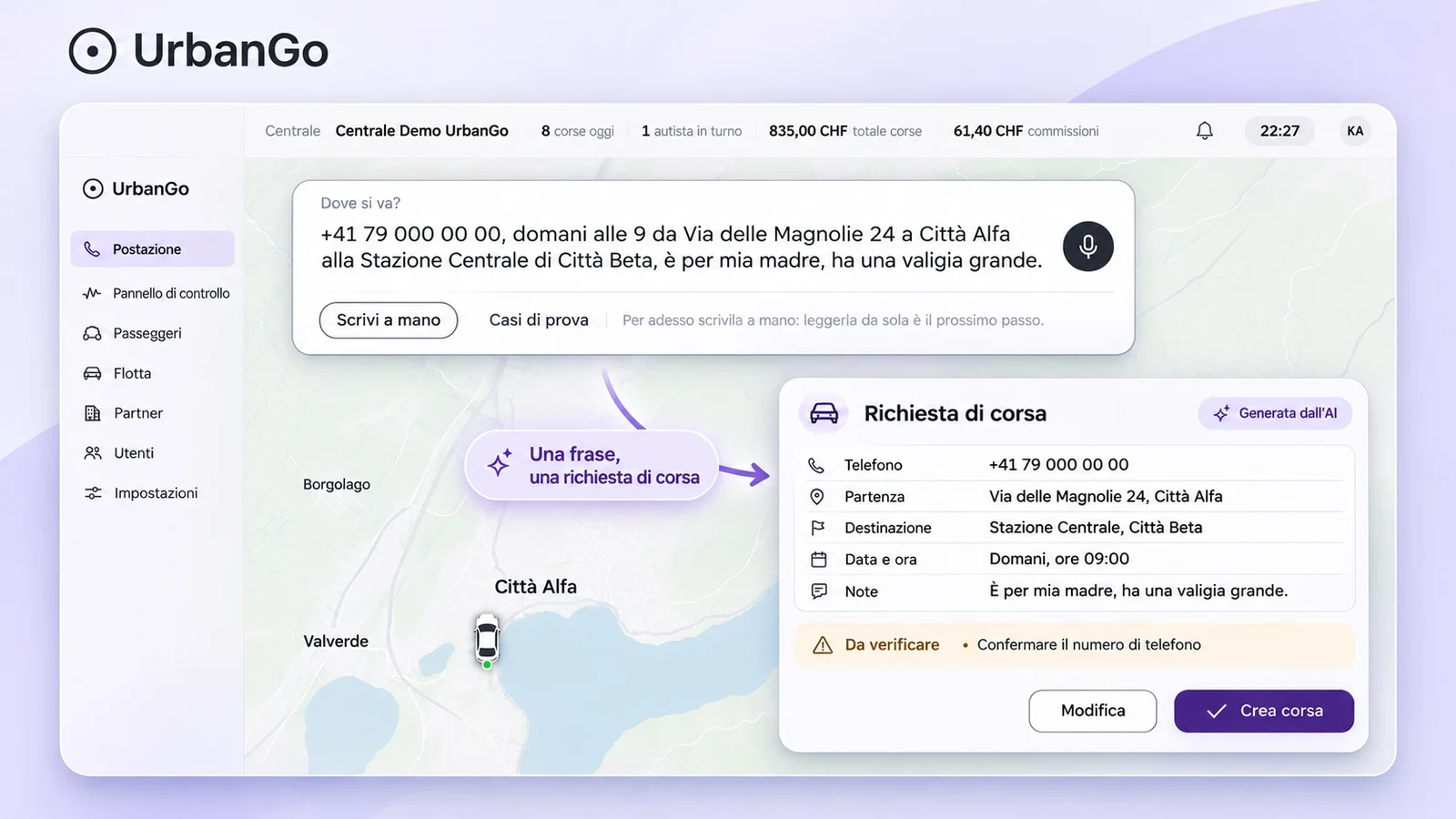
“Tomorrow at 9 AM, pick up my mother at Via delle Magnolie 24 in Città Alfa and take her to Central Station in Città Beta. She has one large suitcase. Contact: +41 79 000 00 00.”
The names, locations and contact number in this example are fictional demonstration data.
A conversational dispatch system can interpret the request and prepare the corresponding journey details: passenger contact, pick-up location, destination, scheduled time and additional instructions. Instead of manually transferring each detail into a separate field, the dispatcher receives a structured request to review.
One sentence becomes the starting point for an entire booking workflow.
UrbanGo is developing this capability for its Dispatch platform. The objective is not to replace the operator’s judgement. It is to reduce repetitive data entry and give dispatch teams a more efficient way to prepare journey requests.
Where information is incomplete or ambiguous, the system should make that uncertainty visible rather than silently inventing an address, time or passenger detail. The operator remains responsible for reviewing and confirming the booking.
For a busy dispatch office, that distinction is essential: technology should simplify the work without removing control over operational decisions.
UrbanGo Dispatch: intelligent technology, independent operators
UrbanGo Dispatch is designed to help taxi companies, private hire operators and dispatch centres manage their daily operations through a digital platform.
But its ambition extends beyond replacing a traditional dispatch console. UrbanGo is developing a mobility infrastructure intended to evolve with the way passengers and businesses request transport.
For independent operators, its value rests on three principles.
Independence: your customers, your business
A local taxi or private hire business is built on relationships. Regular passengers, hotel partnerships, corporate accounts and trusted drivers represent years of commercial work.
Technology should help operators strengthen those relationships, not unnecessarily surrender them.
UrbanGo’s model is designed around the independence of participating operators. Dispatch centres maintain their relationships with customers, affiliated drivers and commercial partners. Drivers propose their own fares, while dispatch centres can apply their own service fees according to the platform’s operating model.
This creates a different proposition from consumer ride-hailing marketplaces that primarily connect passengers through their own branded booking channels.
The software you use should not become your competitor.
Operations: one place to manage the work
Dispatching is much more than assigning the nearest available vehicle. A typical operation must handle incoming requests, live journeys, scheduled bookings, drivers, fares, fees and customer relationships.
UrbanGo brings these activities together in a web-based dispatch environment. For operators accustomed to managing information across calls, messages, spreadsheets and separate tools, a connected workflow offers an opportunity to simplify daily coordination.
The goal is not simply to digitise existing paperwork. It is to provide a clearer operational foundation on which the business can grow.
Innovation: preparing for new booking channels
UrbanGo is integrating natural-language request interpretation into its Dispatch platform. This represents an important step towards conversational taxi dispatch: allowing an operator to describe a journey naturally and receive structured information ready for verification.
It is a developing capability, not a claim that autonomous AI bookings are already available to customers.
In the longer term, UrbanGo intends to explore connections between its mobility infrastructure and external AI assistants. For independent operators, that direction matters because future demand may not always originate from a traditional taxi booking app.
Is your dispatch operation ready for the next generation?
Discover how UrbanGo Dispatch can help modernise ride management while keeping your business relationships and operational decisions in your hands.
Beyond the Uber model: another path for independent mobility
When people search for an alternative to Uber, they often have a straightforward expectation: another app that can provide a ride.
But for taxi companies and private hire operators, the question is different. Is there an alternative way to access modern mobility technology without giving up the independence of the business?
Large ride-hailing platforms have delivered significant technological innovation and convenience. They also operate under commercial models that differ from those of traditional dispatch companies and local operators. There is no single model shared by every platform.
UrbanGo’s approach is to provide digital infrastructure that supports existing transport businesses, their drivers and their customer relationships. It is not positioning itself as an Uber equivalent in terms of fleet size, geographical coverage or consumer reach.
Its alternative lies in the operating model. An independent operator should be able to adopt modern dispatch technology, retain its commercial identity and prepare for new forms of digital booking.
That distinction becomes increasingly relevant as the industry explores AI-powered mobility. The next competitive advantage may not come exclusively from owning the most popular booking application. It may also come from making an operator’s services accessible through the channels passengers choose to use.
The next booking could begin with an AI assistant

Imagine leaving a meeting with your hands full. Instead of opening an app, you say:
“Find me a car to take me home.”
With your permission, an AI assistant has access to your current location and destination. It checks compatible transport services, retrieves available options and presents suitable journeys with their prices and estimated arrival times. You select an option and authorise the booking.
No repeated address entry. No manual search across several apps.
The important change is not replacing a touchscreen with a voice command. It is allowing an assistant to coordinate the request across available services.
For passengers, this could make booking transport more convenient. For operators, it introduces a potentially important new route to customers. A local private hire company might become accessible through an AI assistant even when the passenger has never installed its own application.
That does not eliminate differences in fleet availability, geographical coverage, pricing or brand recognition. But it could reduce dependence on app downloads as the only way to acquire digital bookings.
Where UrbanGo fits into agentic mobility
For this vision to work, AI assistants need reliable connections to transport providers. An assistant must be able to discover services, request availability, retrieve conditions and prices, and manage booking confirmation through authorised interfaces.
These capabilities require more than language understanding. They depend on operational systems, suitable APIs, business rules and interoperability.
UrbanGo already approaches mobility from the infrastructure side, connecting dispatch operations, drivers and journey requests. Its longer-term direction is to explore how that infrastructure could support additional booking channels, including those operated by AI assistants. The natural-language interpretation being developed for UrbanGo Dispatch is one complementary capability within that broader direction.
The ambition is straightforward: make advanced mobility technology accessible to independent operators, not only to the largest platforms.
Direct taxi booking through external AI assistants is not currently an available UrbanGo feature. It remains part of the platform’s future development direction.
Why taxi and private hire operators should act now
The business case for modernising dispatch operations does not depend on predicting when AI assistants will become a common way to book transport. It begins with today’s operational challenges.
Requests arrive through telephone calls, messages, hotel desks, business accounts and digital channels. Drivers need clear instructions. Scheduled bookings require oversight. Pricing agreements and service fees must be applied consistently. The more fragmented these processes become, the harder they are to coordinate.
A connected dispatch platform helps create an operational foundation on which new capabilities can be introduced progressively. This matters whether the next booking comes from a telephone call, a passenger app, a hotel or, eventually, an AI assistant.
It also gives independent operators the opportunity to modernise on their own terms. Rather than waiting for the industry to decide how AI will influence mobility, businesses can begin by improving the tools they already rely on.
Preparing for tomorrow’s mobility starts with taking better control of today’s operations.
Frequently asked questions
What is AI-first mobility?
AI-first mobility describes transport services designed with artificial intelligence as a central capability. AI may support booking interactions, operational decisions, journey planning or fleet analysis. It is an emerging industry concept rather than a universally standardised technical category.
How does AI-powered taxi dispatch software work?
AI-powered dispatch software can assist operators with tasks such as interpreting incoming requests, preparing journey details and supporting operational decisions. In conversational dispatch, a language model extracts information from natural-language instructions and presents it in a structured form for validation and processing.
What are the benefits of conversational taxi booking?
Conversational booking can reduce manual data entry, make complex requests easier to process and potentially reduce transcription errors. The actual benefits depend on how the system is implemented and the operator’s existing workflow, and should be measured in real operations.
Is UrbanGo an alternative to Uber?
UrbanGo offers an alternative operating model for taxi and private hire businesses rather than equivalent consumer coverage. Its platform is designed to support independent dispatch operations while allowing participating businesses to maintain their customer relationships and commercial arrangements.
Can passengers book a taxi directly through ChatGPT?
Integrations between AI assistants and mobility services are emerging, but the ability to complete a booking depends on the provider, location and available integrations. UrbanGo does not currently offer direct bookings through external AI assistants. It is developing capabilities that could support future interoperability.
What is agentic mobility?
Agentic mobility refers to an emerging approach in which AI agents can interact with transport services on a user’s behalf. Depending on the available integrations and permissions, an agent could search for suitable transport options, compare conditions and help complete a booking.
What is the difference between AI-assisted dispatch and agentic mobility?
AI-assisted dispatch supports operators within existing workflows, while agentic mobility focuses on software agents interacting with services and completing authorised tasks. A transport platform can support one approach without necessarily implementing the other.
The future of mobility should not belong to the biggest platforms alone
The history of digital mobility has largely been told through applications, marketplaces and global consumer brands. Artificial intelligence introduces another possibility.
If passengers can increasingly express transport needs through conversational interfaces, future booking channels may become more diverse. That creates an opportunity for local operators, provided their services can be connected to those channels reliably and commercially.
Taxi companies and private hire businesses already possess something technology alone cannot create: experience, licensed operations, professional drivers and relationships within their communities. What they need is access to tools that help them compete and evolve.
UrbanGo is building towards that opportunity, beginning with modern dispatch operations and the integration of natural-language capabilities.
The objective is not to replace the people who keep local transport moving. It is to give them technology that helps them remain independent, competitive and prepared for what comes next.
Discover what UrbanGo could bring to your business
Modernise your dispatch operations, keep control of your commercial relationships and explore a platform designed for the next generation of independent mobility.
Source
- 01Taxi and private hire vehicle statistics, England: 2026Department for Transport · August 2026
Who writes this
UrbanGo is dispatch software for taxi and private hire operators: real-time job management, a partner network and affiliated fleets, control over tariffs and commission. We follow the licensing rules because they are the ground our customers work on.